
Our Impact

Lasting change is never built by one organization alone...
...It is built hand in hand, voice by voice, community by community. Every family wants to see their little ones grow, giggle, and thrive. For families, precious time can be lost trying to understand where to turn and how to get the right support.
For 20 years, ABCD has served as a catalyst, bringing together families, healthcare providers, educators, policymakers, and community partners to build stronger systems to support healthy development for every young child.
How ABCD Creates Change
Building Capacity - Equips providers and communities with training, technical assistance, tools, and best practices.
Centering Families - Ensures lived experience shapes programs, practices, and policy.
Connecting Systems - Brings healthcare, early childhood, communities and families together.
Improving Pathways - Makes screening, referral, and access to services easier to navigate.
Influencing Systems & Policy - Turns what we learn into sustainable statewide change.
Read the 20th Anniversary Impact Report
2006 - 2026: The Difference Two Decades Make
-
Developmental screening was inconsistent in primary care settings.
-
Referral sources, like primary care providers, often didn’t know the outcomes of their referrals and if families were connected to resources.
-
Only three primary care clinics were implementing the HealthySteps model statewide.
Then - 2006
-
Standardized developmental screening is routine in primary care.
-
59 clinics at 6 health systems have implemented a closed-loop referral system.
-
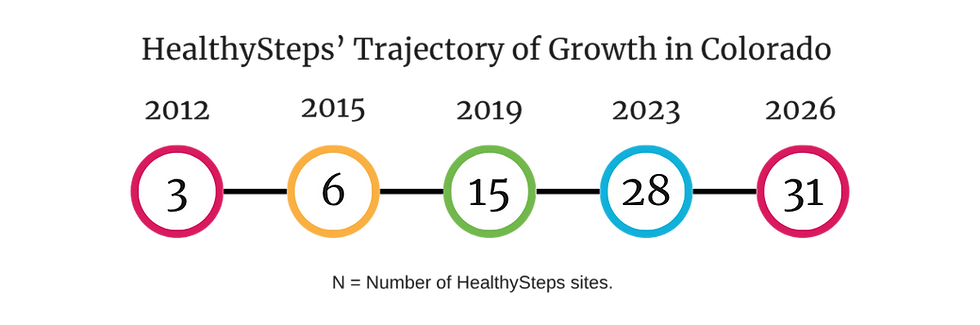
HealthySteps has grown from 3 to 31 sites, reaching over 46,000 children.
-
Families co-design solutions alongside professionals.
-
Communities have tools and frameworks to improve screening and referral.
-
HealthySteps is recognized in state statute.
Now - 2026
ABCD didn’t do this work alone.
We worked alongside government at all levels, partner organizations, and most importantly, families, to transform the early childhood development system in Colorado.
HealthySteps’ Impact
%20(1).png)
HealthySteps is a program of ZERO TO THREEⓇ that promotes healthy development, well-being, and school readiness for infants and toddlers. This national, evidence-based, interdisciplinary program is delivered to families in a place where they already are: primary care clinics. It is a two- generational (2-Gen) program that supports both children and caregivers, particularly low-income families, in an environment that is responsive to families’ language and culture.


Making an Impact Through Co-Design
Co-design means creating with people, not for them — sharing power to identify priorities, make decisions, and develop solutions together. - Beyond Sticky Notes
San Luis Valley
In partnership with ZERO TO THREE’s Evidence to Impact Center, ABCD brought families and community partners together in the San Luis Valley to redesign how families access developmental support. Twenty community conversations and a 10-family co-design group identified opportunities to improve parent mental health support, individualized care, confidentiality, and referrals.
That learning helped inform a new closed-loop electronic referral system that connects healthcare and Early Intervention, implemented in partnership with the Colorado Department of Public Health and Environment, the Colorado Department of Early Childhood-Early Intervention Colorado and local health systems. Together, these efforts strengthened communication and coordination across the systems families rely on.

Together with Healthy Child Care Colorado, we launched the Healthy Universal Preschool Collaborative (HUPC) to integrate developmental, oral health, hearing, and vision screening into Universal Preschool programs. Through partnerships with Local Coordinating Organizations, Child Care Health Consultants, Universal Preschool providers, and families, HUPC supports communities in co-designing screening and referral processes that reflect local needs and resources. Together, partners build local capacity through training and technical assistance, promote early screening and healthy habits, and strengthen pathways that connect children and families to timely care.
The Healthy Universal Preschool Collaborative is made possible through generous funding from Delta Dental of Colorado Foundation.

The Family Experience Network Impact
.png)
Family Experience Network Concept Map
ABCD’s Family Experience approach creates a continuous cycle of listening, co-designing, and learning. We gather family insights, put co-designed improvements into practice, measure whether family experiences improve, and use what we learn to keep adapting.
.png)
By the Numbers

Learn the Signs. Act Early. (LTSAE)
Developmental monitoring helps families understand how their children are growing, learning, and developing—and recognize when they may need additional support. As Colorado's Learn the Signs. Act Early. Ambassador, ABCD's Eileen Auer Bennett helps bring accessible developmental milestone resources to families and the professionals who support them.
Through the CDC's LTSAE program, ABCD has distributed materials to hundreds of families and providers, supporting parent-engaged developmental monitoring and earlier identification of developmental concerns.

Advocating for Policies that Support Families
When changes at the practice or community level aren’t enough, ABCD works to change the early childhood system.
ABCD has actively led policy efforts to:
1. Standardize Medicaid Reimbursement Requirements for Developmental Screening
Prior to 2011, primary care practices in Colorado were being reimbursed for developmental screenings. However, there were no standards or generally agreed-upon tools for providers. ABCD advocated that primary care practices should only be reimbursed for developmental screening if they use a standardized, validated screening tool as outlined by the American Academy of Pediatrics. Learn more about screening in Colorado.
2. Close the Referral Loop
Now, more health systems know the outcome of their referrals because they implemented an electronic closed loop referral system. Learn more here.
3. Incorporate HealthySteps into State Statute
In 2025, ABCD partnered with Healthier Colorado and the Colorado Department of Early Childhood, to support the introduction and passage of SB25-017, a bill that codified HealthySteps in state statute in the Department of Early Childhood. Also known as Measures to Support Early Childhood Health, the bill was sponsored by Sens. Lisa Cutter (D-Jefferson County) and Iman Jodeh (D-Aurora) and Reps. Junie Joseph (D-Boulder) and Yara Zokaie (D-Fort Collins). This helps create a foundation for long-term, statewide sustainability.
“The most important investment we can make is in the health and well-being of Colorado’s kids. I was proud to support this bill to help ensure that young children across our state receive the critical developmental screenings and early interventions they need to grow into healthy, successful adults.”
- State Senator Lisa Cutter (D-Jefferson County)

